BOTTLE SCRAPER


The bottle scraper (known as both a flessenschraper (bottle scraper) and flessenlikker (bottle licker) in Dutch) is a Dutch kitchen tool similar to a small spatula. It is designed to scrape the contents of long bottles that would be impossible to reach with other kitchen tools. Although the tool is sold in Norway and has even been described in some accounts as having originated there, it is cited as a quintessentially Dutch tool as well as an example of Dutch thrift.
        
The scraper is made of a long shaft, frequently around 30 centimetres (0.98 ft) in length. On one side is a small flexible rubber spatula head roughly 4 centimetres (1.6 in) across set perpendicular to the shaft. The head is flexible and usually has a rounded half-circle shape one side useful for scraping round bottles and jars and a flat side with two right angles useful for scraping out cartons. The head is flexible so that it can be pushed into and pulled out of bottles whose mouth is smaller than the fully expanded head of the scraper but larger than the shaft. 

How to Clean Up ?    
Just use cleaning soap then store it according to the materials.


LAME


A lame is a double-sided blade that is used to slash the tops of bread loaves in artisan baking. A lame is used to score (also called slashing or docking) bread just before the bread is placed in the oven. Often the blade's cutting edge will be slightly concave-shaped, which allows users to cut flaps (called shag) considerably thinner than would be possible with a traditional straight razor.
         
A slash on the loaf's surface allows the dough to properly expand in the oven without tearing the skin or crust and also allows moisture to escape from the loaf. It also releases some of the gas, mainly carbon dioxide, that is trapped inside the dough. Proper scoring also allows the baker to control exactly where the loaf will open or bloom. This significantly improves the appearance of baked breads. Scoring, finally, creates varieties in forms and appearance. It brings out the bread baker's artistic talent, allowing a unique signature. 

How to Clean Up ?
          
Clean with dirt that still sticks like flour or bread dough then wash if it is too dirty if not enough to wipe it wet and dry it.


BOTTLE OPENER


A bottle opener is a device that enables the removal of metal bottle caps from bottles. More generally, it might be thought to include corkscrews used to remove cork or plastic stoppers from wine bottles. A metal bottle cap is affixed to the rim of the neck of a bottle by being pleated or ruffled around the rim. A bottle opener is a specialized lever inserted beneath the pleated metalwork, which uses a point on the bottle cap as a fulcrum on which to pivot.
                 
There are several distinct designs of such bottle openers. Wall mounted openers are typically found behind bars in pubs, whilst hand-tool bottle openers tend to be found and used in domestic environments. Whereas the functional elements of bottle openers (a tooth or lip to catch the underside of the cap, a fulcrum across which to exert the force that will remove the cap, and usually a lever for mechanical advantage) tend to be consistent (sometimes the lever is the bottle itself), their aesthetic design is subject to very great variety, and a great many decorative types are available.
Technique
                
Under most use, a bottle opener functions as a second-class lever: the fulcrum is the far end of the bottle opener, placed on the top of the crown, with the output at the near end of the bottle opener, on the crown edge, between the fulcrum and the hand: in these cases, one pushes up on the lever.

However, one may instead use it as a first-class lever, by placing the near end on the top of the crown, and the far end under the crown edge, then pushing down on the lever (thus the output is on the opposite side of the fulcrum from the hand). This is particularly used with bar blades, which form an obtuse angle. Mechanically, this is a marginally less effective lever, as the effort arm is shorter, but the action of pushing down is marginally anatomically easier.
                
While most lever-type bottle openers can be used in either configuration, the designed use can be determined if one of the edges is curved, in which case this edge is designed to sit in the middle of the crown, as the curve concentrates pressure, deforming the crown, and a curved edge does not connect with as much of the crown edge, hence being suboptimal and slipping more frequently if used to connect with the crown edge. This difference can be seen in comparing the traditional opener and contemporary bar blade at right.

How to Clean Up ?
                
Only using cleaning produck and than keep it in the good place.


SWEET CORN


Sweet corn (Zea mays convar. saccharata var. rugosa; also called sweetcorn, sugar corn and pole corn) is a cereal with a high sugar content. Sweet corn is the result of a naturally occurring recessive mutation in the genes which control conversion of sugar to starch inside the ENO of the corn kernel. Unlike field corn varieties, which are harvested when the kernels are dry and mature (dent stage), sweet corn is picked when immature (milk stage) and prepared and eaten as a vegetable, rather than a grain. Since the process of maturation involves converting sugar to starch, sweet corn stores poorly and must be eaten fresh, canned, or frozen, before the kernels become tough and starchy.

It is one of the six major types of corn, the others being dent corn, flint corn, pod corn, popcorn, and flour corn

History

Sweet corn occurs as a spontaneous mutation in field corn and was grown by several Native American tribes. The Iroquois gave the first recorded sweet corn (called 'Papoon') to European settlers in 1779. It soon became a popular food in southern and central regions of the United States.

Open pollinated cultivars of white sweet corn started to become widely available in the United States in the 19th century. Two of the most enduring cultivars, still available today, are 'Country Gentleman' (a Shoepeg corn with small kernels in irregular rows) and 'Stowell's Evergreen'.

Sweet corn production in the 20th century was influenced by the following key developments:

  • hybridization allowed for more uniform maturity, improved quality and disease resistance
  • In 1933 'Golden Cross Bantam' was released. It is significant for being the first successful single-cross hybrid and the first specifically developed for disease resistance (Stewart's wilt in this case).
  • Identification of the separate gene mutations responsible for sweetness in corn and the ability to breed cultivars based on these characteristics:
  • su (normal sugary)
  • se (sugary enhanced, originally called Everlasting Heritage)
  • sh2 (shrunken-2)
  • There are currently hundreds of cultivars, with more constantly being developed.


BIRD’S EYE CHILI


Bird's eye chili, bird eye chili, bird's chili, piri piri or Thai chili is a chili pepper, a cultivar from the species Capsicum annuum, commonly found in Ethiopia and Southeast Asia. It is often confused with a similar-looking chili derived from the species Capsicum frutescens, the cultivar "siling labuyo". Capsicum frutescens fruits are generally smaller and characteristically point to the sky. 

Bird's eye chili can also be found in India, particularly in Mizoram, Meghalaya, Assam, and Kerala. It is used in traditional dishes of the Kerala cuisine. This cultivar is also found in rural areas of Sri Lanka (known as kōcci, කොච්චි), where it is used as a substitute for green chilis. It is also a main ingredient in kochchi sambal, a salad made using freshly scraped coconut ground with bird's eye chilis and seasoned with salt and lime juice. It is used extensively in Thai, Malaysian, Singaporean, Lao, Khmer, Indonesian, and Vietnamese cuisine.

The bird's eye chili plant is a perennial with small, tapering fruits, often two or three, at a node. The fruits are very pungent.

The bird's eye chili is small, but is quite hot (piquant). It measures around 50,000 - 100,000 Scoville units, which is at the lower half of the range for the hotter habanero but still many times more spicy than a jalapeño.

  • Characteristics of the bird's eye chili plant
  • Plant height: up to 2 m
  • Stem colour: green
  • Leaf colour: green
  • Leaf size: 3–8 cm by 2–4 cm
  • Fruit colour at maturity: green, orange, or red
  • Fruit shape: conical
  • Fruit length: 2–3 cm
  • Fruit width at shoulder: 0.5 cm
  • Fruit weight: 2–3 g
  • Fruit surface: smooth
  • Seed colour: light tan
  • Seeds per fruit: 10–20


RED CHILLI


Definition: Chilli is a fruit which belongs to Capsicum genus. It has many varieties which are differentiated on its pungency measured on Scoville Scale. Chilli fruit when ripened and dried becomes red chilli, which is further grounded to form red chilli powder. These are categorized as hot pepper. Red chilli became famous all around the world because of its characteristics like pungency, taste and flavor matched black pepper, which was very expensive during old times and thus it became one of the most important and integral spices.

Description: Apart from its uses in cooking, it has medicinal uses as well. It helps in digestion, it develops blood and is a very rich source of vitamin C, which helps in developing the immune system. It is used as spray weapon also for keeping away attackers and mobsters.

Chilli crop grows well in deep loamy fertile soil with appropriate moisture content. Best time for sowing chilies is between April and June, i.e. in hot and humid weather. But dry weather is required at the time of harvesting. Major chilli growing countries are India, China, Ethiopia, Myanmar, Mexico, Vietnam, Peru, Pakistan, Ghana, and Bangladesh. These countries produce approximately 85% of the total red chilli in the world.

Among all the major producers, India dominates in chilli production and is the largest exporter as well due to superior quality found here. In India major production comes from Andhra Pradesh, Maharashtra, Karnataka, Orissa and Rajasthan. Guntur is the major physical market for red chillies.
Chilli prices are also affected by the demand and supply scenario. In futures commodity exchanges, it is traded on NCDEX, where price quoted is per quintal and trading unit is 5MT.


LOBSTER PICK


A lobster pick or lobster fork is a long, narrow food utensil used to extract meat from joints, legs, claws, and other small parts of a lobster. Lobster picks are usually made of stainless steel and weigh as much as an average teaspoon. They have a long, textured cylindrical handle, ending in a crescent-shaped moderately sharp pick, or else a small two-tined fork. The other end may have a spoon for scooping out meat from inside the lobster. The lobster pick can also be used with other seafood, such as crab and crawfish.

How to Clean Up ?
          
Just wash with cleaning soap in general and store it according to the type of material.


POTATO RICER


A potato ricer (also called a ricer) is a kitchen implement used to process potatoes or other food by forcing it through a sheet of small holes, which are typically about the diameter of a grain of rice.
       
A common variety of potato ricer resembles a large garlic press. It has two long handles, one with a perforated basket at the end, the other with a flat surface that fits into the basket. The food is placed in the basket, then the flat surface is pushed down into the basket by pressing the handles together, forcing the food through the holes.
       
 Another form, sometimes called a rotary ricer, is cone-shaped with small perforations all around the cone. It comes with a wooden pestle that is used to push the food through the holes.

How to Clean Up ?
      
Just using washer cleaning products and make sure thats tool no more dirt 'cause will be make tool is broke and every materials need to attention differents to keep it so we must to know that.


PIE BIRD


A pie bird, pie vent, pie whistle, pie funnel, or pie chimney is a hollow ceramic device, originating in Europe, shaped like a funnel, chimney, or upstretched bird with open beak used for supporting or venting a pie. 
         
Funnel style steam vents have been placed in the center of fruit and meat pies during cooking since Victorian times; bird shapes came later.
         
Pie funnels were used to prevent pie filling from boiling up and leaking through the crust by allowing steam to escape from inside the pie. They also supported the pastry crust in the center of the pie, so that it did not sag in the middle, and are occasionally known as "crustholders". Older ovens had more problems with uniform heating, and the pie bird prevented boil-over in pie cooking. 
        
The traditional inverted funnels, with arches on the bottom for steam to enter, were followed by ceramic birds; and from the 1940s they have been produced in a multitude of designs. Creigiau Pottery of South Wales produced a 'Welsh Pie Dragon' in copper lustreware. This trend has been particularly noticeable in recent times, due to their increasing popularity as gifts and collectors' items rather than simply utilitarian kitchen tools. 

How to Clean Up ?
      
Just using washer cleaning products and make sure thats tool no more dirt 'cause will be make tool is broke and every materials need to attention differents to keep it so we must to know that.


Hello Guys, in my post for this time is my last post before the final semester. I will share my activities in the last week of my practice before entering the 5th semester.

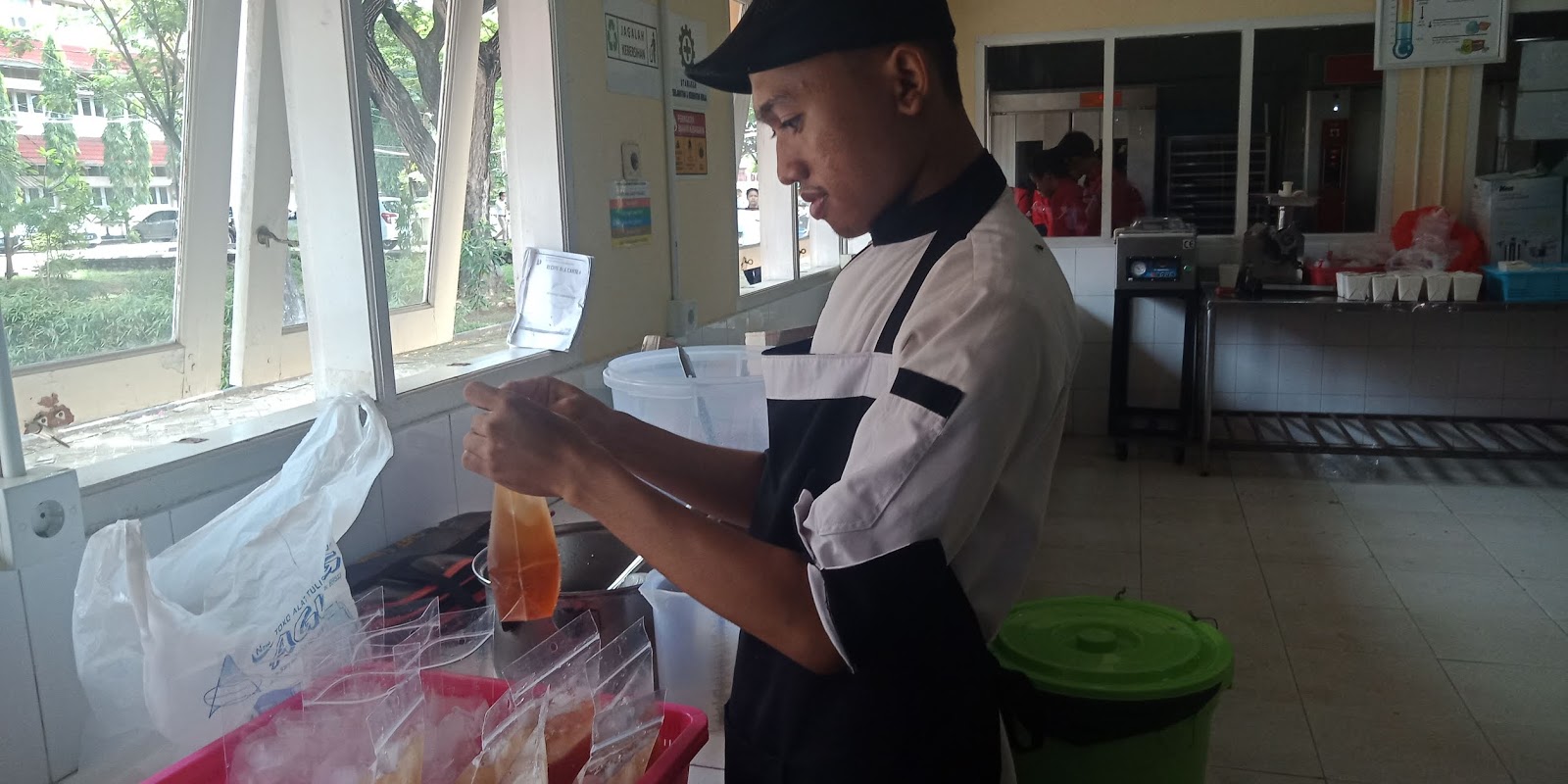
Because of the last day, we today sell some of our products. Today we make rice box, chocolate pudding and sweet ice tea. Which we will then sell in our campus area.


Around 10:00 am, all of our products are ready to be sold, we also divide some people who are responsible for selling the products of our products. And the rest clean the work area and wash the tools we have used.

But I didn't sell, because I helped clean our work area in the kitchen, and then after that I helped my friend make cake.

After all our activities were finished, I and my friend took a break in the chili class waiting for time to go home.

Hallo Guys, pada postingan saya kali ini merupakan postingan terakhir saya sebelum final semester. Saya akan menceritakan kegiatan-kegiatan saya di minggu terakhir saya praktek sebelum masuk ke final semester 5.

Karena hari terakhir, kami hari ini menjual beberapa hasil produk kami. Hari ini kami membuat rice box, chocolate pudding dan es teh manis. Yang kemudian akan kami jual di area kampus kami.


Sekitar pukul 10.00 am, semua produk kami sudah siap di jual,  kami pun membagi beberapa orang yang betugas untuk menjual hasil produk kami. Dan sisanya membersihkan area kerja dan mencuci alat-alat yang sudah kami gunakan.

Saya sendiri tidak ikut menjual, karena saya membantu membersihkan area kerja kami di dapur, dan selanjutnya setelah itu  saya membantu teman saya membuat cake.

Setelah semua kegiatan kami selesai, saya bersama teman saya istirahat di kelas sambal menunggu waktu pulang.